

- (18/03/26) BBC Gladiator joins London Sport at Mitcham Market for multi-sports session for local children, showing how we can use London’s spaces to get kids more active.
- This comes one year after the launch of award-nominated ‘More Ball Games’ campaign help remove hundreds of ‘No Ball Games’ signs – but meaningful action still needed to protect children’s health.
12 out of the 15 local authorities with the lowest number of publicly accessible facilities per 10,000 people are located in London.
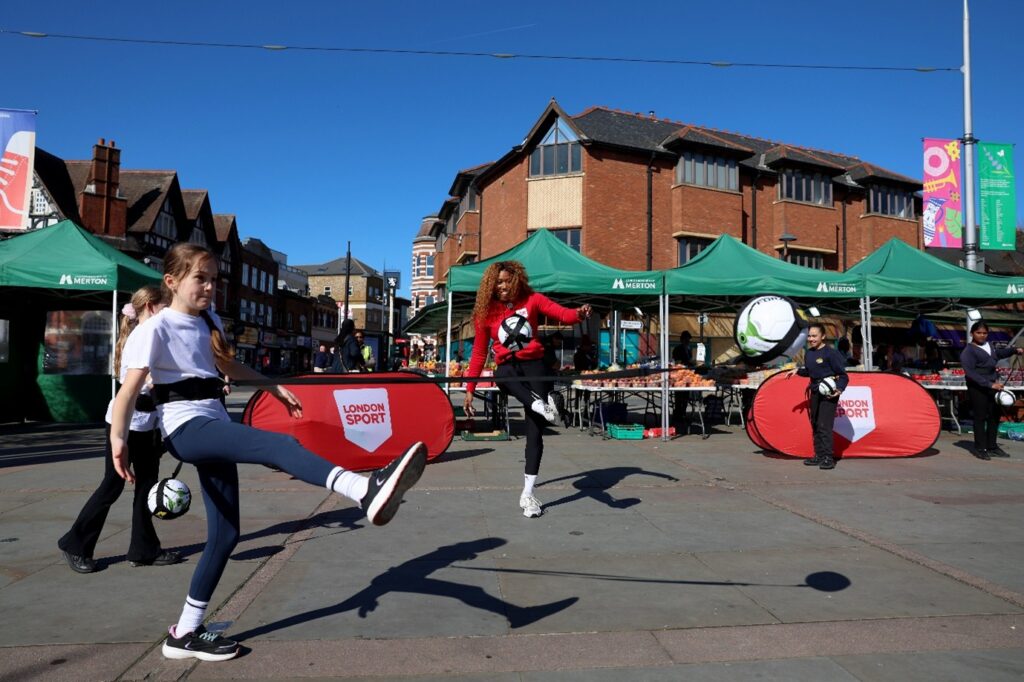
Earlier this afternoon, London Sport was joined by GB Olympian and BBC Gladiator, Montell Douglas, and young people, community leaders and sports influencers at Mitcham Market in Merton for a multi-sports session – keeping active alongside traders and shoppers alike, showing how London’s neighbourhoods can be designed and used in creative ways to break down barriers to accessing physical activity, giving opportunities for every child to be active close to home.
Children across London are rapidly running out of safe places to play, London Sport has warned today, as the charity calls on councils to redesign streets, estates and neighbourhoods to tackle a growing play space crisis.
This activation marks one year on from London Sport’s award-nominated More Ball Games campaign – launched with Lambeth Council at the Mursell Estate, alongside local leaders and the London Lions basketball team. It also comes soon after the London Borough of Merton set out its ambition to become London’s first Borough of Sport.
March 2026 marks the next phase of the campaign. London Sport has had a positive response from up to nearly a third of London boroughs – such as Merton, Lambeth, Brent, Waltham Forest, Barnet, Haringey, Westminster and Lewisham – with other councils in advanced discussions. These councils are now working to finalise arrangements to review and remove barriers to physical activity and play, including the removal of restrictive ‘No Ball Games’ signs.
Since the launch of this campaign, hundreds of these signs have already come down, unlocking more public spaces for children to play informally – but London Sport warns removing signs is just the first step.
We must shift from banning to play to designing for it.
Access to facilities is increasingly fragile in London, with 12 out of the 15 local authorities with the lowest number of publicly accessible facilities per 10,000 people being located in the capital. With London’s population now around 9 million, and set to grow by almost 400,000 in the next decade, demand for space will intensify while access to sports facilities remains unequal and many community spaces face growing pressure.
Without action, children – particularly those in deprived communities – risk fewer opportunities to be active, worsening health inequalities, obesity and mental health.
Montell Douglas, Olympic sprinter, bobsledder, star of BBC ‘Gladiators’ and London Sport Ambassador, said:
“Every child deserves the chance to be active, to play, and to discover what they’re capable of. Informal play is often where that journey begins. Removing barriers like ‘No Ball Games’ signs is a huge step forward, but we must go further and design communities that actively encourage movement.”
Emily Robinson, CEO of London Sport, said:
“The removal of No Ball Games signs shows what’s possible when councils act. But this is just the beginning. We cannot build enough new facilities to meet future demand – we must unlock the spaces we already have.
This is about fundamentally rethinking how London works – designing streets, town centres, estates and neighbourhoods so that activity is part of everyday life. Where a child lives should never determine whether they have the chance to play, be active and live healthily.”
Ross Garrod, Leader of Merton Council, said:
“Merton is proud to support the More Ball Games campaign and our ambition to become London’s first Borough of Sport reflects our commitment to creating healthier, more active communities. By rethinking how our estates and public spaces are used, we can give every child the opportunity to play, connect and get active”.
Caroline Cooper-Marbiah, Cabinet Member for Sport and Heritage, Merton Council said:
“It has been wonderful to see all the young people enjoying physical activity in a space that is not usually considered for sport. Activating nontraditional spaces and using equipment innovatively just shows how easy it can be to participate and have fun”.
A blueprint for change
With local elections approaching in May, London Sport is also leaders to take bold action which puts play and physical activity at the heart of urban design, including:
- Embed physical activity in planning, ensuring new developments include accessible spaces for informal sport and play, aligned with Sport England’s Active Design principles.
- Strengthen community engagement in development design by working with London Sport and its partners from the earliest stages.
- Remove barriers to play by reviewing restrictive “No Ball Games” signage, supporting the direction of the More Ball Games campaign.
- Unlock underused spaces by repurposing vacant or overlooked sites for community physical activity.
- Pilot balanced, proportionate approaches that retain powers to manage genuine anti-social behaviour while enabling play.
This forms part of London Sport’s new Manifesto, which was published today, warning that without urgent action, London’s growth risks worsening childhood health inequalities.
ENDS
Media contact: Lucy Bishop [email protected]
Notes to editors:
About London Sport
London Sport is a not-for-profit organisation, part of a national network ,championing physical activity in London’s most deprived communities. We share insights, influence decision makers and allocate funding to effect change.
We are a strategic leader, working to remove barriers to physical activity by facilitating policy, funding and delivery.
