

As London’s schools re-open their doors to pupils after the summer holidays, one of the capital’s biggest untapped assets for sport and physical activity – the sports halls, gyms, studios and swimming pools that sit inside our school estate – remain out of reach for most.
Building on London Sport’s latest research: Planning for London’s Active Future, published in June, which showed London needs significantly more Health & Fitness Gym, Sports Hall and Studio capacity to keep pace with population growth and an ageing population, we wanted to understand something else: how much of the capacity we already have is sitting behind locked school gates, unused by anyone beyond the school day.
Using Active Places Power data, we looked at four facility types: Sports Halls, Health & Fitness Gyms; Studios; and Swimming Pools – and analysed who owns them, how much of that stock is available only for private use, and how many hours a week each type is actually open.
A lot of London’s stock sits inside schools
Education is one of the largest single owners of sport and physical activity facilities in London. Across the four facility types we looked at, schools and colleges own:
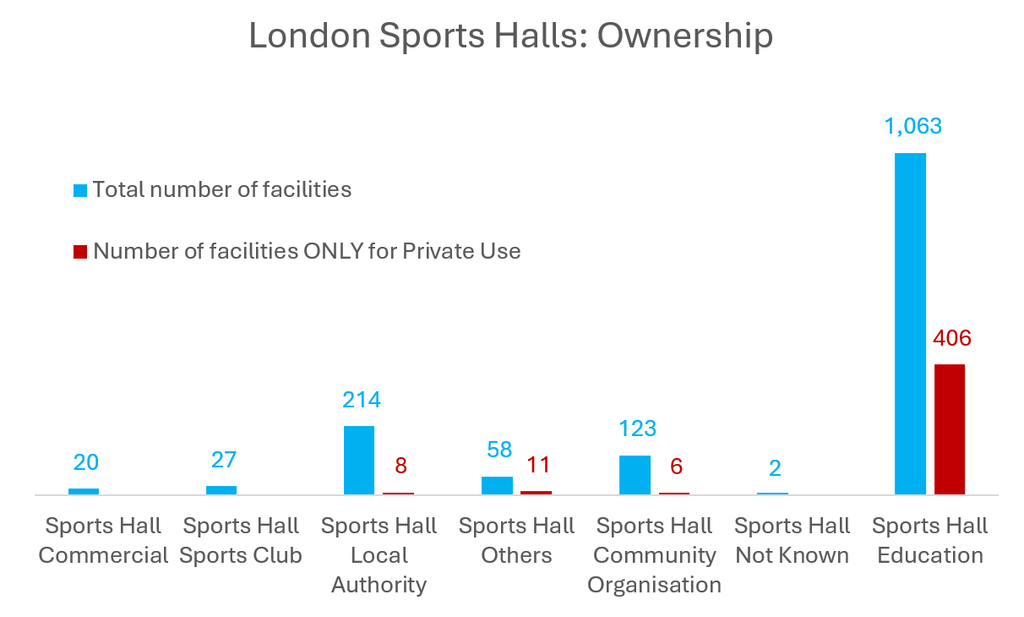
- 1,063 Sports Halls
- 367 Studios
- 309 Health & Fitness Gyms
- 117 Swimming Pool facilities
That’s a striking concentration of infrastructure. It also means that decisions about how school facilities are used, and how open they are to the wider community, have an outsized effect on how much sport and physical activity opportunity actually exists in London.
Much of it is locked to the public
Across every facility type, education-owned sites have by far the highest proportion of facilities that are never available beyond private use: 406 of the 1,063 Sports Halls; 193 of the 309 Health & Fitness Gyms; 86 of the 367 Studios and 51 of the 117 Swimming Pools.
And when they are open, hours are the lowest of any owner
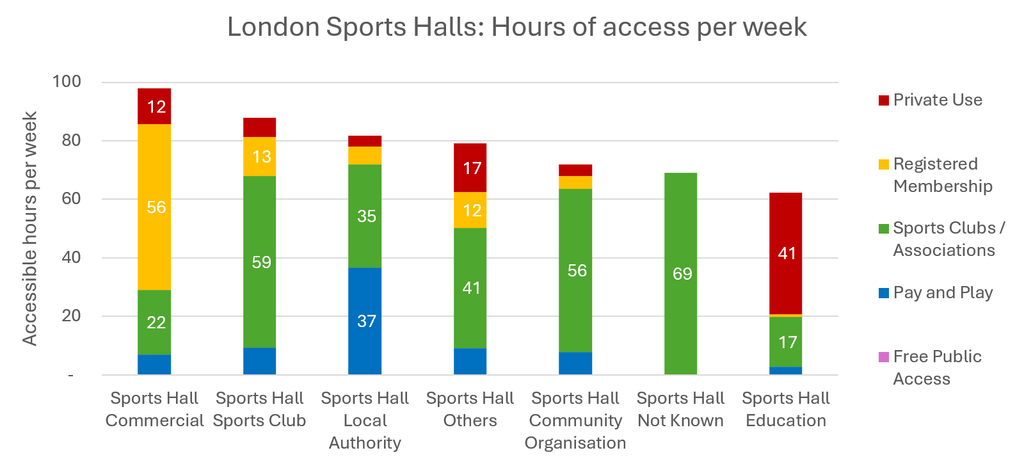
Education-owned facilities also have the fewest operational hours per week of any ownership type, and by a wide margin. Commercial facilities average around 130 hours a week open in some form; education-owned Health & Fitness Gyms average closer to 60. The same pattern holds for Sports Halls, Studios and Swimming Pools. Of the hours education facilities are open at all, the majority are for private use rather than community access, membership, or pay-and-play.
None of this is a surprise on its own. The school day – including breakfast and after-school clubs – naturally limits how many hours a facility can be available for anything else, and we wouldn’t expect a school gym to run the same hours as a commercial one. But it raises an obvious question: what would happen if schools opened their doors more like a commercial owner?
The opportunity is bigger than it looks
We modelled what would happen if education-owned facilities extended their opening hours to match commercial facilities, and made those additional hours available to the wider community. The results were striking. The additional capacity this would unlock is worth, in effect:
- 386 extra Sports Halls
- 169 extra Health & Fitness Gyms
- 126 extra Studios
- 46 extra Swimming Pools
To put that in context, opening up school facilities to the level of commercial owners would deliver several times over the additional capacity that population change will require, without building a single new facility.
At a local level, this matters even more. In our least well-served boroughs (Barking & Dagenham, Brent, Lambeth, Lewisham, Newham and Tower Hamlets) simply opening existing school facilities, even on a more modest basis than a commercial operator would, would be enough to meet the additional need those boroughs face from population change. Do nothing, and provision in these boroughs gets worse, not better, by 2035.
We already know this can work
This isn’t just a modelling exercise for London Sport. We’ve run this model.
Between 2023 and 2025, on behalf of the Department for Education, London Sport distributed the Opening School Facilities (OSF) fund across the capital, helping schools open their sport facilities (including school swimming pools) to more young people and their local community. Across three funding rounds, OSF funded 195 schools in 29 boroughs and delivered over 24,000 sport and physical activity sessions, beating its target for children and young people’s participation.
It also showed where the friction sits. Community-user numbers fell short of target, several schools needed support to open safely and accessibly, and grant funding couldn’t cover the capital repairs many facilities need before they can open their doors at all.
National OSF funding ended in March 2025 and hasn’t been renewed, despite the programme beating its own targets – a decision the Culture, Media and Sport Committee’s 2026 Game On report also challenged, warning that closing the fund without a replacement had left facilities underused despite clear demand, and calling for its continuation. The London Sport data makes the case for scale; OSF proves it can be delivered; what’s missing now is the funding to do it again – including for pools, at a moment when the Mayor and his team wants London to become more swimmable.
The bottom line
This isn’t a call to fling open every school gym at 6am on a Saturday. OSF already shows what’s possible, and what it takes to get there: looking seriously, borough by borough and facility by facility, at where a modest extension of opening hours could unlock community access at a fraction of the cost of new build, backed by funding that lasts. As the school term gets under way, the facilities London needs to tackle its sport and physical activity capacity gap may already be built – we just need to find, and fund, better ways to open the doors.
